
Klosters is better known for mountains than museums, but there is more to the village than skiing and walking.
Its cultural interest comes partly from its history: a medieval monastery, the arrival of Walser settlers, traditional wooden buildings and the later development of Klosters as an international holiday resort.
Today, visitors can explore that history at the Nutli-Hüschi museum, see stained glass by Augusto Giacometti in St Jakob church, watch independent cinema at the Kulturhuus or attend concerts ranging from chamber music to major classical performances.
The cultural programme changes through the year, so this guide concentrates on the places and institutions that form a permanent part of Klosters rather than trying to maintain a fixed calendar of events.
Table of Contents[Hide][Show]
- Culture in Klosters at a glance
- Nutli-Hüschi: the place to start with Klosters history
- Why Klosters is called Klosters
- Kulturhuus Klosters and Cinema 89
- Klosters Music
- The cultural side of Klosters is not just for summer
- Walser history and traditional buildings
- Discover Klosters on foot
- Klosters Library
- Culture with children
- What to do on a wet day
Culture in Klosters at a glance
| If you are interested in… | Start with… |
|---|---|
| Local history | Nutli-Hüschi |
| Traditional Klosters life | Nutli-Hüschi and the area’s Walser heritage |
| Film, theatre and smaller concerts | Kulturhuus Klosters |
| Classical music | The current Klosters Music programme |
| Historic architecture | St Jakob church |
| Modern architecture | The Sunniberg Bridge |
| A quiet indoor stop | Klosters Library |
| Current exhibitions and performances | The Klosters cultural events calendar |
| A larger art museum | The Kirchner Museum in Davos |
Nutli-Hüschi: the place to start with Klosters history
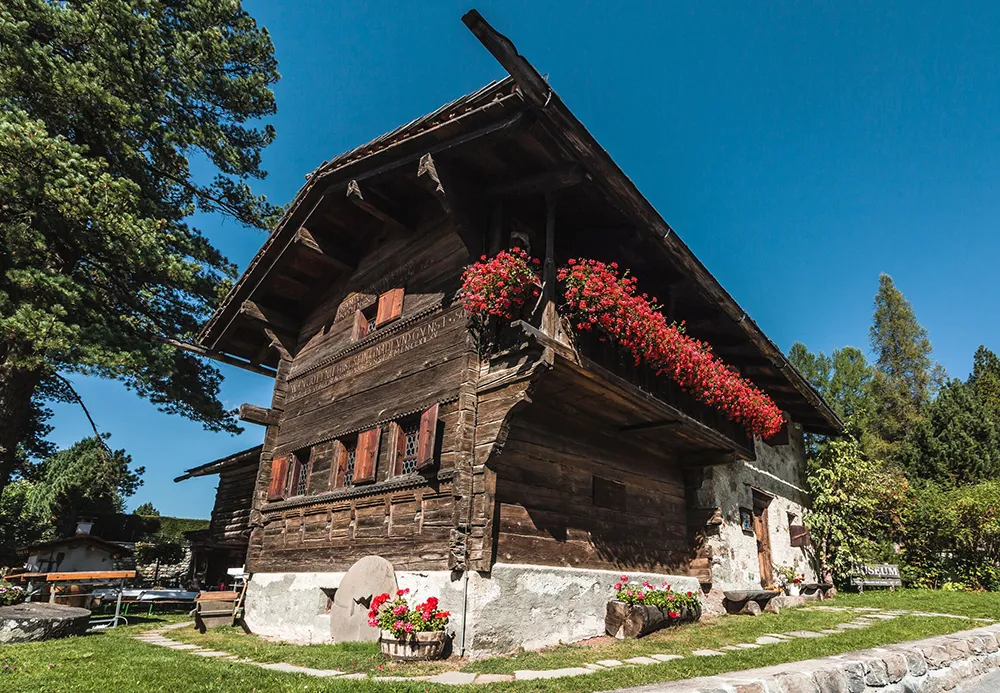
If you want to understand what Klosters was like before hotels, ski lifts and international tourism, start at Museum Nutli-Hüschi.
The building is a traditional Walser house dating from the 16th century. It was bought and restored in 1918 and has operated as a museum since 1925.
Inside are furniture, household objects, agricultural tools and other items from Klosters and the surrounding area. Rather than attempting to tell the whole history of Graubünden, the museum concentrates on everyday life in this part of the Prättigau.
The museum complex has also expanded beyond the original house, with a stable and the Bachhüschi adding further space.
Special exhibitions change, and opening periods are limited, so this is somewhere to check before setting out rather than simply turning up.
Good for: local history, traditional architecture and a rainy afternoon.
Why Klosters is called Klosters
The name itself is part of the village’s history. A Premonstratensian monastery dedicated to St James and St Christopher was established here in the early 13th century. The settlement that developed around it eventually took its name from the monastery. Kloster is the German word for monastery.
The monastery itself has disappeared, but its site remains important because the present Reformed Church of St Jakob stands there. Understanding that connection makes the centre of Klosters rather more interesting than simply walking past the church on the way to the station.
St Jakob church
The Reformed Church of St Jakob is one of the most important historic buildings in Klosters. Its oldest surviving element is the Romanesque tower, which dates from the 13th century. The church occupies the site of the medieval monastery from which Klosters took its name.
The reason many visitors should go inside, however, is much more recent.
Augusto Giacometti’s stained-glass windows
In 1928, Swiss artist Augusto Giacometti created three stained-glass windows for the choir of St Jakob. Their subject is Jacob’s Dream. The central window depicts Jacob sleeping and dreaming of the ladder linking earth and heaven, while the side windows include shepherds, sheep and plant forms. The strong colours and dark lead lines are characteristic of Giacometti’s stained-glass work and make the windows worth seeking out even if churches are not normally part of your holiday itinerary.
St Jakob is also used for concerts, including performances associated with Klosters Music and other seasonal programmes.
Kulturhuus Klosters and Cinema 89
For contemporary cultural life, the most useful place to know is Kulturhuus Klosters. It is a small cultural venue rather than a large municipal arts centre, and that scale suits Klosters. The programme can include cinema, theatre, concerts, readings, cabaret, talks and other live performances.
Cinema 89 operates here and specialises in a varied studio-film programme rather than simply showing mainstream releases. Around 70 to 100 screenings are typically staged during the year. The programme changes regularly, so it is worth checking what is on during your stay.
For visitors looking for something to do on a wet evening or a day away from the mountains, this is one of the first places we would check.
Klosters Music
Klosters Music has become one of the village’s most important cultural events. Founded in 2019, the festival brings established international classical musicians and ensembles to Klosters.
The main programme takes place in summer and uses venues including Arena Klosters, while a developing programme of church concerts brings music into St Jakob at other times of the year. Previous programmes have included major orchestras, soloists, chamber music and vocal performances.
Rather than listing performers or dates here, we recommend checking the current programme directly. The line-up changes each year and tickets for individual concerts can sell well in advance.
If you are already considering a summer visit, it is worth checking the festival dates before finalising your accommodation.
The cultural side of Klosters is not just for summer
Klosters Music gives summer culture a high profile, but performances continue outside the main summer festival.
The Kulturgesellschaft Klosters organises theatre, concerts, readings and film screenings, while St Jakob and other venues are used for seasonal music.
Winter can also bring local celebrations and traditional events. One example is the Sächsi Schällätä, which traditionally marks the beginning of the winter season in Klosters with bells, fire, music and family activities. December programmes can also include classical Christmas concerts in St Jakob.
The exact programme varies from year to year, so our advice is simple: if you are staying for more than a couple of nights, check the current events calendar. There is often something happening that would be very difficult to discover simply by walking around the village.
Walser history and traditional buildings
Klosters lies within an area shaped by Walser settlement. The Walsers established communities across high Alpine valleys, and traces of their farming life, dialect and building traditions remain visible around Klosters. Wood was particularly important in local construction, although there is no single universal style that can accurately be called “the Walser house”.
The most obvious place to learn about this heritage is Nutli-Hüschi, but traditional buildings can also be seen in places such as Monbiel and Schlappin. This makes a walk through the quieter parts of Klosters more interesting if you know what you are looking at.
Rather than treating the old barns and houses merely as attractive Alpine scenery, they are part of the story of how people lived and farmed in a difficult mountain environment.
Hotels, Guest Houses and Self-catering in Klosters
Discover Klosters on foot
The official summer Guest Programme has included a guided Discover Klosters walk covering the village’s history, its monastery origins and its development into an internationally known resort.
The programme is seasonal and individual tours may only be offered in German, so check the current details before booking.
Even without a guided tour, central Klosters is compact enough to explore independently. A simple cultural walk could combine St Jakob, Klosters Library, the village centre and Nutli-Hüschi, before continuing towards Monbiel if you want to turn it into a longer walk.
Klosters Library
Klosters Library is opposite St Jakob church in the old town hall, known as the Jeuchenhaus. Part of the building is more than 300 years old, and the reading room makes an interesting contrast with the modern tourist infrastructure elsewhere in the village. The collection includes books for adults and children, local material and some English-language books.
For most holidaymakers this will not be a major attraction in itself, but it is useful to know about, particularly during poor weather, for families staying several weeks or for anyone interested in local history.
Architecture in Klosters
The architecture of Klosters tells several different stories. At one end are the wooden houses, farm buildings and barns associated with the agricultural village. At another are the hotels and chalets that appeared as Klosters developed as a summer and winter resort.
And then there is one striking piece of modern Swiss engineering.
Sunniberg Bridge
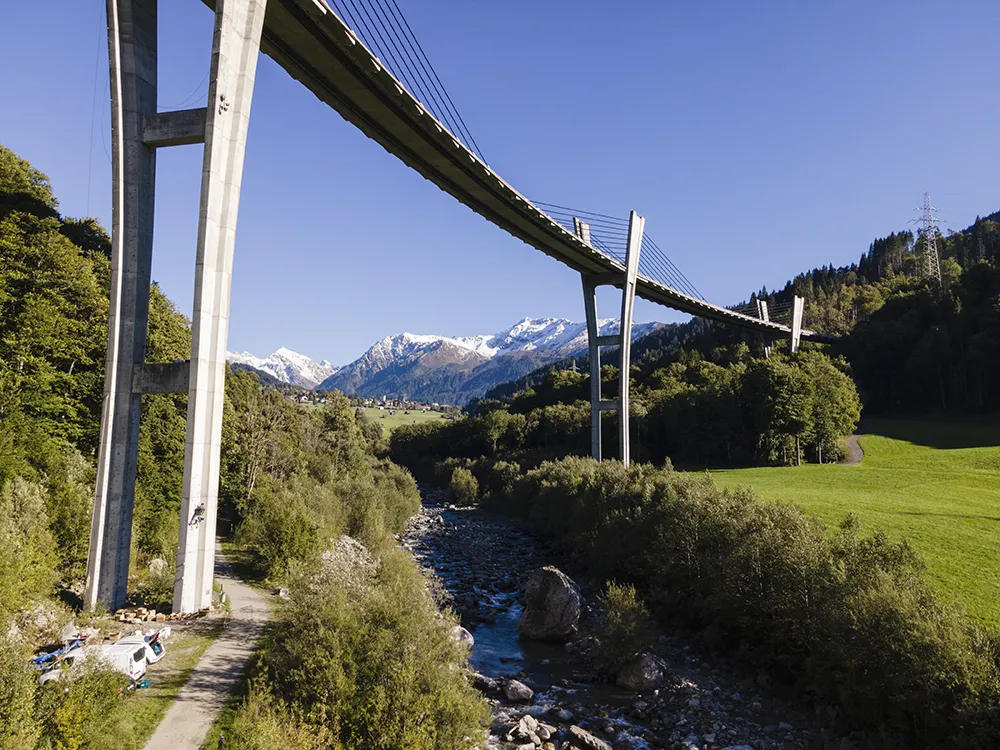
The Sunniberg Bridge forms part of the Klosters bypass and was designed by Swiss civil engineer Christian Menn. Rather than dominating the valley with heavy concrete, the cable-stayed structure curves across it on slender outward-leaning pylons. It has attracted international attention for the way the engineering works with the landscape rather than simply crossing it. You do not need to be an engineer to appreciate it. The bridge is an interesting example of something modern being added to an Alpine landscape without pretending to be traditional.
Art and exhibitions
The art scene in Klosters changes more frequently than its museums and historic buildings. Private galleries, temporary exhibitions and individual art projects can appear for a season and then change, which makes a permanent list surprisingly difficult to keep accurate.
We therefore do not recommend planning a visit around an old list of gallery names. Instead, check the current Klosters cultural events and exhibition listings shortly before your trip.
A larger art museum: Kirchner Museum Davos
Klosters itself does not have a major fine-art museum. For that, neighbouring Davos is the obvious choice.
The Kirchner Museum Davos holds the world’s largest collection of work by German Expressionist Ernst Ludwig Kirchner, who lived and worked in Davos from 1918 until his death in 1938. The modern museum building was designed by architects Annette Gigon and Mike Guyer and has become architecturally significant in its own right. Exhibitions rotate, so it is worth checking the current programme rather than assuming particular works will always be on display.
Davos is easy to reach from Klosters by rail, making the museum a practical half-day trip, particularly in poor weather.
Culture with children
Families should not expect large interactive museums or theme-park-style attractions in Klosters. There are, however, some worthwhile cultural options.
Nutli-Hüschi can work with older children who are interested in how people once lived in the mountains, while Cinema 89 provides an obvious indoor option when a suitable film is showing. Seasonal events and the Guest Programme can also include family-oriented cultural activities.
For a wider selection of family ideas, see our Klosters with Children guide.
What to do on a wet day
Culture becomes particularly useful when the weather stops a planned mountain day. A straightforward poor-weather combination might be Nutli-Hüschi, lunch in Klosters and an afternoon film or performance at Kulturhuus. Another option is to take the train to Davos, visit the Kirchner Museum and return to Klosters for dinner.
The library is another easy option if you want something quieter.
For restaurant ideas, see our Eating & Drinking in Klosters guide.